
Beyond the Horizon: Trinity Jo-Li Bliss on Acting, Music, and Growing Beyond Limits

At an age when most teenagers are still figuring out who they want to be, Trinity Jo-Li Bliss has already accomplished so much. She's slipped into the skins of Na’vi warriors, navigated the emotional landscapes of coming-of-age songwriting, worked with some of the biggest stars in film, and found her place in two of Hollywood’s most anticipated projects of the decade.
Yet if you ask her how she sees herself, she doesn’t speak with the certainty of someone accustomed to the spotlight. Instead, she answers with the sincerity of a young artist who still treasures walking to crafty with Zoe Saldaña or holding Sigourney Weaver’s hand during makeup calls.

“I feel like I’ve just begun and I have a long way to figure out,” she says. “There’s still so much to discover.”
She says it lightly, but the sentiment reveals a grounded awareness: that a life in storytelling - whether through lyrics or motion capture - means constantly learning, continually stretching, and consistently becoming. That earnestness, the soft-spoken mix of humility and curiosity, is one of the first things you notice about Trinity. The second is how deeply she appreciates the people who shaped her journey.
Trinity was only eight when she stepped onto the Avatar set, joining a cast that had been part of Pandora for years. The scale might have overwhelmed another young performer, but Trinity walked in without hesitation.
“I really didn’t think about it then,” she laughs. “It’s like my dog, who is 9 pounds and looks like a golden retriever tossed into a dryer. My dog always goes up to the big dogs and never thinks he’s a small dog. If I may say, I just might’ve been that small dog when starting the Avatar journey around 8 years old.”
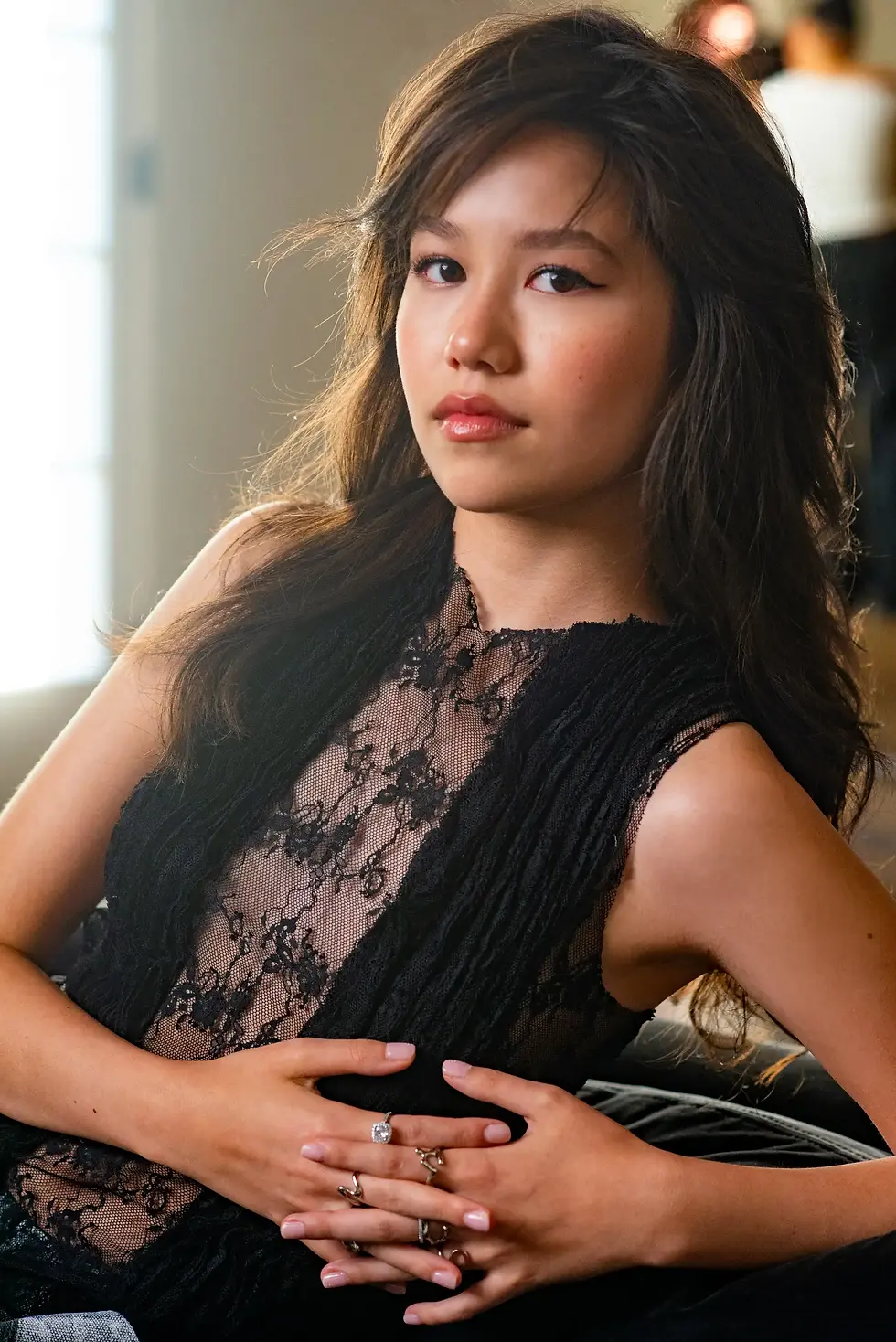
It is an unexpectedly perfect metaphor: unaware of any size difference, driven purely by excitement.
Her earliest memories from set aren’t about technology or the reality of acting in “the Volume.” They’re about people, the grown-ups she adored long before just how renowned they were in the eyes of the rest of the world really set in.
“Zoe and Sig are some of the most kind and passionate people I’ve ever met,” she says. “As a child, at the time, I had no idea how ‘legendary’ or ‘masterful’ both Zoe and Sig were. I just found them to be really cool people that I looked up to and loved spending time with.”
With Zoe Saldaña, the connection came naturally. “I loved getting snacks from Crafty with her or knocking on her trailer door to serenade her with my guitar,” she remembers. With Sigourney Weaver, the dynamic felt almost familial. “She’s the best big sis anyone could ask for. She’s so smart and playful. I loved getting book recommendations from her or holding her hand while we got our makeup done for the day.”
The affection in her voice is unmistakable. Far from hero worship, this was genuine love.
If her castmates helped her find comfort, James Cameron helped her find depth. Trinity talks about him with a mix of awe and real warmth.
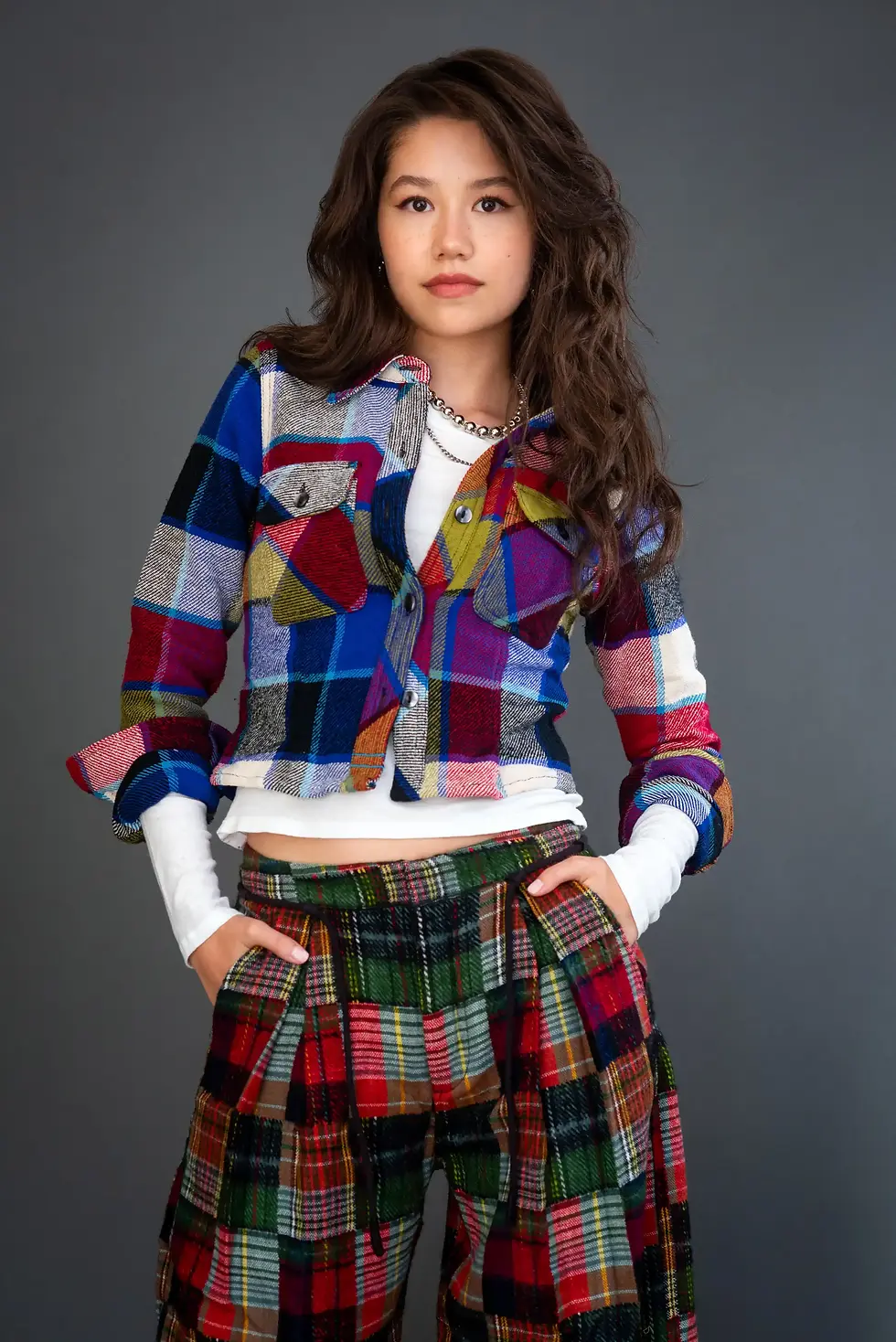
“He really prioritises performance and how performance shapes storytelling,” she says. “I love getting to play with him. It’s the most fun and cosmic process.” She laughs a little at her own phrasing, then adds: “I could listen to him talk forever, and, it might sound silly, but I always feel more intelligent after each conversation with Jim.”
Working with Cameron, she explains, is a process of constant discovery. It's more about the character, the emotional truth, and the world around her than the story alone. They built Tuk together, piece by piece, guided by curiosity and intention.
Most people imagine performance capture as highly technical: dots, cameras, blank stages. But for Trinity, the gray box of “the Volume” became an imaginative playground.
“What might surprise people is that it’s the most liberating form of acting,” she says. “It’s a playground for the actors, for the director, and for our imaginations. We get to submerge ourselves in a flow state and can forget about everything else.”
She explains that when she’s present with her character, the technology fades away. “I forget about all of that when connected to my character, when compelled by the story, and when my heartstrings are pulled for all the little details… and then I’m just focused on my other actors. Jim spends so much care and detail to place us in the mindset of the scene and what is going on around us.”
It’s startling how vividly she remembers those details, how her imagination filled the empty space, how her scene partners grounded her, how the emotional stakes felt completely real.
For a role steeped in physicality, Trinity’s preparation was equally intensive. Years of training in Na’vi movement, free diving, archery, knife work, and parkour shaped her understanding of Tuk and the world she inhabits.
“Free diving probably challenged me the most because of the long breath holds and learning how to calm my mentality when we’re deep underwater,” she says.

But the moment that stayed with her most vividly came on land, not in the water.
“My strongest memory, when I think of tough training moments, is when I burst into tears and was so stuck about a backwards roll in parkour,” she says. “I wanted to keep up with ‘the older kids’ so bad and felt so pathetic that I couldn’t sometimes. I just could not get this backwards roll right!”
What followed is something she describes with embarrassment, yet also with affection and gratitude.
“Somehow, my castmate, Britain, who truly did feel like an older brother figure, gave me a huge hug and told me, ‘Don’t worry. We all feel your pain. You got this!'”
She went home and practiced the roll “over and over again.”
The training, she says, did far more than teach her physical skills.
“The training process really helped me get into Tuk physically and emotionally,” she says. “It was a way to deepen my connection and understanding with how she’s grown up, the relationships around her, the way she moves, her culture… all of it!”
Beyond acting, Trinity’s other universe is music: a personal one, shaped by her diary, her imagination, and the echoes of teenage life around her.
Her next project, she explains, is “dreamy, cinematic pop from my diary.”
“Cinematic because of my acting influence,” she says, “which inspires me to write visual, storytelling lyrics.”
Being homeschooled, she found herself longing for the everyday moments of high school she observed from afar.
“I often hear the cheers, laughter, the dance floor anthems… all drifting from my local high school down the street,” she says. “I guess I channel that yearning into my lyrics around the butterflies, the awkward moments, the discovery, the want, and even fairytale hope.”
Her music is deeply intertwined with her acting.
“In my experience, they’ve played into each other so much,” she says. “I love writing songs from a character’s perspective. I also love getting inspired by a character in a self-discovery type of way when it comes to songwriting about myself.”

She speaks just as warmly about the Berklee Summer Conservatory, which she attended recently.
“I’d always written on my bedroom floor and wondered if my songs could see the light of day,” she says. “The conservatory gave me opportunities to realize how powerful collaboration is and can be!”
As a biracial artist, Trinity carries her visibility with quiet purpose.
“I didn’t always see kids who looked like me or families that felt like mine in the shows and movies I loved when growing up,” she says.
That’s why being part of Avatar means so much to her.
“Authentic representation is a really powerful thing,” she says. “When you see yourself on your screen, you feel like your story matters, and everyone deserves to experience that.”
She speaks not only of seeing herself reflected, but of learning from stories beyond her own.
“Even when it’s not a story I relate to as much on screen, I find it so cool to be given the chance to immerse myself in these stories, characters, and themes, which all give me more perspective as a person.”
Despite all she has already achieved, Trinity sees her future not as a trajectory but as an unfolding.
“I feel like I’ve just begun and have a long way to figure out,” she says again, almost as if reminding herself. “There’s still so much to discover.”
She hopes the stories she tells, in film or song, will connect with people in meaningful ways.

“I hope the stories of Tuk and many characters I’ll play will continue to resonate with people and people like me,” she says. “I hope that the songs I write straight from my heart connect with people and give them a space to feel. I hope I can make a difference in this world. I wanna leave every person or place better than I found them.”
It’s a gentle ambition; one that feels entirely within her reach.
Still discovering.
Still becoming.
Still reaching beyond the horizon.


I was comparing several ways to source Turkish goods when I came across the idea of using a centralized wholesale platform instead of contacting factories individually. I decided to see how it worked in practice and used TuranLine for one of my orders. My first step was simply browsing the catalog and getting an idea of how the assortment was organized. There are different groups of products on the platform, from clothing and footwear to accessories and textiles, which made it easier to compare related items in one session. I selected the products I needed and placed them into the cart, then went through the checkout procedure and arranged payment. The experience was fairly uncomplicated, but I paid particular attention…
One legend shared https://motorbooks.co.uk/ with me after a really messy breakup, mostly just to get some peace. One night when I was tossing and turning for the life of me, I decided to take a look and was genuinely surprised by how quiet the atmosphere was—not loud or intrusive at all. I poured myself a drink, got comfortable, and finally felt my head settle after weeks of tension. I ended the night having a proper yarn with someone new and everything just flowed. It was exactly the kind of mental reset I needed.