
SELKIE Sets Sail on The Ghost Ship for Fall/Winter 2026

Photography by Easelle Cho.
They say we're not supposed to have favorites, but we're going to have to make an exception for this season.
During New York Fashion Week, SELKIE’s Fall/Winter 2026 runway presentation was a standout for me because of the immersive experience that SELKIE and the team crafted, as well as the intricate attention to detail in suturing the audience into a world that transcends space and time, laughter and tears, through fashion.
Backstage after the show, we were fortunate enough to catch a few words from none other than SELKIE founder and designer Kim Gordon about the meaning behind the collection and the show that she had just put on. I'll have to say, the conversation we had, along with the runway show, has stayed with me even now.

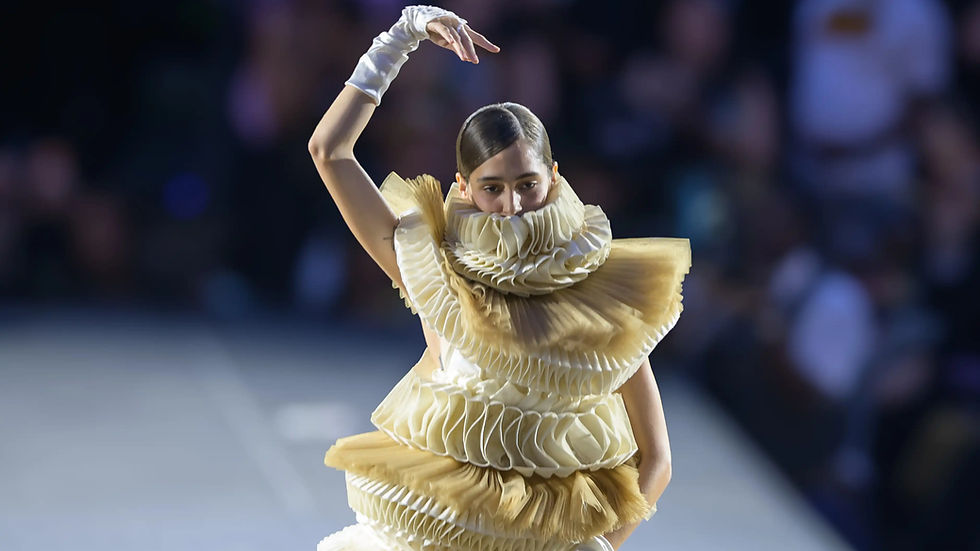
The experience began as something far beyond the conventional runway show. The first model emerged like a figure already inhabiting another world - part contortionist, part ballet dancer - twisting, bending and weaving through the crowd in a striped, ruffled look that immediately established the show’s sense of theatrical unease. She would return again at the very end, after the full cast had taken its finale walk, closing the circle with one last performance.

It was an apt beginning for a collection built around performance itself.
Titled The Ghost Ship, SELKIE’s FW26 collection takes its emotional center from Cheryl Strayed’s essay of the same name, in which Strayed considers the alternate lives created by every consequential decision: the lives that remain imaginable once another path has already been chosen. For Kim Gordon, the idea became the foundation for a collection about choice, regret, spectacle and freedom.
“It was really inspired by choice, and the choice, in general, in your life,” Gordon told me after the show. “You can only make one choice, and it’s yours to make, and there’s nothing you can do about it. You can think of it as like a ship that you never boarded, and all you can do to that ship you didn’t board is wave, salute it from the shore.”
Inside the show space, that metaphor became something almost physical. The runway was washed in haze, giving the room a misty, ethereal quality as models appeared through the atmosphere like figures emerging from memory, or from some imagined vessel drifting between worlds.
The clothes heightened that sense of fantasy. Gordon translated circus iconography through SELKIE’s familiar romantic vocabulary: harlequin diamonds, striped shirting, corsetry, lace, ribbons, puffed sleeves, sweeping skirts and exaggerated ruffles appeared alongside fur-trimmed outerwear, military-style jackets and pieces that felt scavenged from several different eras at once.
Black-and-white diamond prints recurred throughout the collection, sometimes in short, flared silhouettes and sometimes expanded into voluminous gowns. Red appeared with equal force, from a richly layered corseted mini dress to an elongated harlequin look paired with an oversized white coat. Elsewhere, soft pink florals and lavender tones pulled the collection back toward SELKIE’s more recognizably romantic territory.
The effect was not a literal circus wardrobe so much as the remains of one: costumes worn by performers who had kept going long after the tent came down. That image was central to Gordon’s thinking.
“I’ve been thinking a lot about choice, making the way of social media, and the performance that we have to put on every day,” she said. “We put on performance in our lives for different people, you know, as human beings, and we also perform on social media.”
For Gordon, the clown became an especially potent symbol. In contemporary internet language, calling someone a clown is a shorthand for ridicule. Gordon took that insult and pushed it back toward its theatrical origins.
“One of the things that people use to bring others down on social media is to call them a clown, that clown emoji, I kept seeing it. And the whole performance thing, the performative, the word performative, and the circus, ‘what a circus.’ And I thought, you know what, let’s talk to one on a show. So this is a show about performance.”
The styling deepened that idea. Several models wore headphones connected to portable cassette players or radios, turning each figure into someone seemingly moving through the same environment while listening to a private soundtrack. Books were strapped to bodies like survival equipment. Bows, cords, ribbons and loose ties trailed from garments, giving the collection a slightly improvised, post-apocalyptic feeling, as though these characters had dressed themselves from whatever beauty, memory and cultural debris remained.

The casting reinforced the same sense of individuality. Models of different body types moved through the runway, including a wheelchair user dressed in a military-inspired black jacket over a pale metallic corseted look. Rather than flattening everyone into a single visual archetype, the presentation allowed each person to feel like a distinct character within the same strange traveling company in which music was essential to that world.
The soundtrack drew heavily from mid-century pop and girl-group recordings, giving the show the feeling of an old radio transmission drifting through the fog. Songs including “He’s Got the Power” by The Exciters and “Remember (Walkin’ in the Sand)” by The Shangri-Las brought a sweetness and melancholy that contrasted with the collection’s imagery of catastrophe and survival.
That tension - romantic nostalgia against an imagined apocalypse - was one of the show’s strongest devices. The clothes could be playful, even deliberately theatrical, but the atmosphere around them carried something more unsettled. And then came the finale.
As the cast returned for its final walk, “Laugh, Clown, Laugh” played through the room, bringing Gordon’s clown metaphor into its clearest focus. What could easily have become camp for camp’s sake instead landed as something more bittersweet: performance as both burden and survival mechanism.
After the models disappeared, the opening performer returned alone, dancing once more through the runway space. The gesture made the show feel less like it had ended than looped back to where it began.
For all its apocalyptic language, though, The Ghost Ship is not ultimately nihilistic.
“It’s about creativity, and art, and love, surviving anything,” Gordon said. “Apocalypse, there’s nothing to fear when there’s creativity, and art in the aftermath, and humans will always have that.”
That may be the clearest way into the collection. Beneath its clowns, pirates, ghosts and circus girls is an argument for creation as a form of endurance.
If The Ghost Ship is about the lives we do not choose, SELKIE’s FW26 runway was equally interested in what we do with the life that remains.
Dress for it. Perform it. Be inspired, as I was. Make something beautiful aboard the ship you are already on.


Comments