
New York Fashion Week Spring/Summer 2027: The Collections That Defined the Season

New York Fashion Week Spring/Summer 2027 was a week of very different worlds.
From KHAITE's romantic anniversary collection to Sabyasachi's return to New York after two decades, Christian Siriano's fairytale-inspired runway, the emerging designers of New York Men's Day, and The Blonds' unapologetic celebration of twenty years, every show seemed to have its own universe.
That is what I enjoy most about Fashion Week. You can spend one hour looking at clothes that feel incredibly familiar and the next looking at something that completely changes your idea of what a collection can be.
This season, I found myself drawn to the shows that had a very clear point of view. Not necessarily because they were the loudest or the most dramatic, but because you could tell exactly what the designer wanted you to see.
KHAITE
KHAITE felt like one of the strongest examples of a brand allowing itself to evolve without losing what makes it recognizable.
For Spring/Summer 2027, Catherine Holstein celebrated 10 years of KHAITE with a collection that explored a softer, more romantic side of the brand. Lace, chiffon, corsetry, crinolines, sheer fabrics and sculptural leather came together in a collection that still felt unmistakably KHAITE, just with a little more softness.
What immediately caught my attention was the contrast.
There were delicate fabrics against substantial leather. Body-conscious silhouettes were balanced by exaggerated volume. There were pieces that felt almost vintage in their femininity, but they were styled in a way that kept everything grounded in the KHAITE woman we already know.
And after ten years, that felt like the right way to celebrate the brand. Not by completely changing it, but by showing another side of it.
COACH
Coach approached its 85th anniversary by looking directly into its archive.
Stuart Vevers worked with familiar Coach materials and signatures, including leather, denim, tailoring and archival accessories, but instead of simply recreating pieces from the past, he treated them as things that could be taken apart and made new again.
Vintage pouches became new bags. Leather and denim were reworked. Pieces had a slightly worn-in, collected quality that made the collection feel lived in rather than overly polished.
I loved that it did not feel like a traditional anniversary collection.
There was no pressure to make everything look archival just because the brand was celebrating its history. The history was there, but it was being used.
SABYASACHI
Sabyasachi was one of the shows that stayed with me long after leaving the venue.
For Spring/Summer 2027, “Bengal Byzantine Broadway” marked his return to New York for his first runway show in the city in 20 years, presented at The Metropolitan Museum of Art. The show also marked the beginning of a multiyear collaboration with the museum, including high jewelry inspired by its Byzantine collection and produced in India.
There was already something incredibly fitting about Sabyasachi presenting at the Met.
His work has always been so deeply connected to history, craftsmanship, objects and the idea of collecting pieces that feel like they have lived several lives. Putting that sensibility inside one of New York's most important cultural institutions made the entire presentation feel larger than a runway show.
And then you actually looked at the clothes.
The collection moved between the American West, India, Bengal, Byzantine references and the theatricality of Broadway. There were indigo jeans, plaid shirts, cowboy hats and denim, but then those familiar Western references were transformed through Sabyasachi's very specific language of embroidery, brocade, jewels, hand-painted silks and intricate construction.
One of the pieces that really stayed with me was a cow-print jacket made from embroidered pieces patchworked onto tulle. It took what could have been an incredibly literal Western reference and turned it into something much more intricate.
That was happening throughout the collection. Nothing felt like a simple translation of one culture into another. The title really said it all: Bengal, Byzantine, Broadway. Three completely different worlds, brought together in one collection.
The jewelry was another major part of the story. Drawing from the Met's Byzantine holdings, the pieces were produced entirely in India, creating this beautiful connection between the museum's collection and Sabyasachi's own craftsmanship.
As a South Asian fashion creator, there was obviously a personal element to seeing this collection presented in New York. But beyond that, I think it was simply exciting to see an Indian fashion language given this kind of space within the official New York Fashion Week conversation.
It did not feel like Sabyasachi was trying to fit into New York. He brought his own world with him. And New York made room for it.
CAROLINA HERRERA
Carolina Herrera's Spring 2027 collection was one of those shows where the setting felt just as important as the clothes.
The house celebrated its 45th anniversary at the David H. Koch Theater at Lincoln Center, surrounded by 28,798 yellow tulips. Wes Gordon chose the number very intentionally, even explaining that his children had each taken a tulip during rehearsals.
Before the models even came out, the space already felt like Carolina Herrera.
And then the collection began with black-and-white polka dots, immediately bringing you back to the codes that have defined the house for decades.
The crisp white shirt appeared throughout the collection, but Gordon continued to play with it. It was tucked into a cummerbund over cigarette pants, transformed into shirtdresses, and paired with fuller, sheer skirts. There were dramatic gowns, floral elements, headscarves, oversized sunglasses and the kind of polished eveningwear that feels synonymous with Herrera.
But there were also these very specific New York references.
A silk twill headscarf and oversized sunglasses gave one look the feeling of a woman hailing a cab on Park Avenue. A collarless trench brought another version of that same woman into the present
.
I think that is what I liked most about the collection. It understood that Carolina Herrera is a very specific kind of New York fashion, but it did not treat that identity as something frozen in the 1980s.
Gordon also looked directly at the house's history through collaborations with the Warhol Foundation and The New Yorker. One shift dress reproduced Andy Warhol's iconic portrait of Herrera, while an organza T-shirt and dress were beaded with a New Yorker cover from the week of Herrera's first show
.
Even the small details had a story. Gold frog brooches were a reference to Herrera's favorite restaurant, La Grenouille.
That is the kind of thing I love in a collection. You can appreciate the big gown when it comes down the runway, but then you learn about the tiny detail hidden in the collection and suddenly you want to go back and look at everything again.
The entire show felt like a celebration of Carolina Herrera, but also of New York itself.
And after 45 years, that feels pretty special.
CHRISTIAN SIRIANO
Christian Siriano took us somewhere completely different.
His Spring 2027 collection was inspired by the eighteenth-century French fairy tale The Story of the Queen of the Flowery Isles, a story that Siriano was drawn to because of its darker beginning and softer, dreamlike ending. That contrast became the foundation for the collection.
The show actually began much darker than I expected.
Black faux-leather pieces opened the collection, including laser-cut trenches and gowns, followed by a series of black tailoring looks. There were cropped tuxedos, sharply cut suits and sexier trousers, giving the first part of the collection a slightly sinister feeling. Then everything changed.
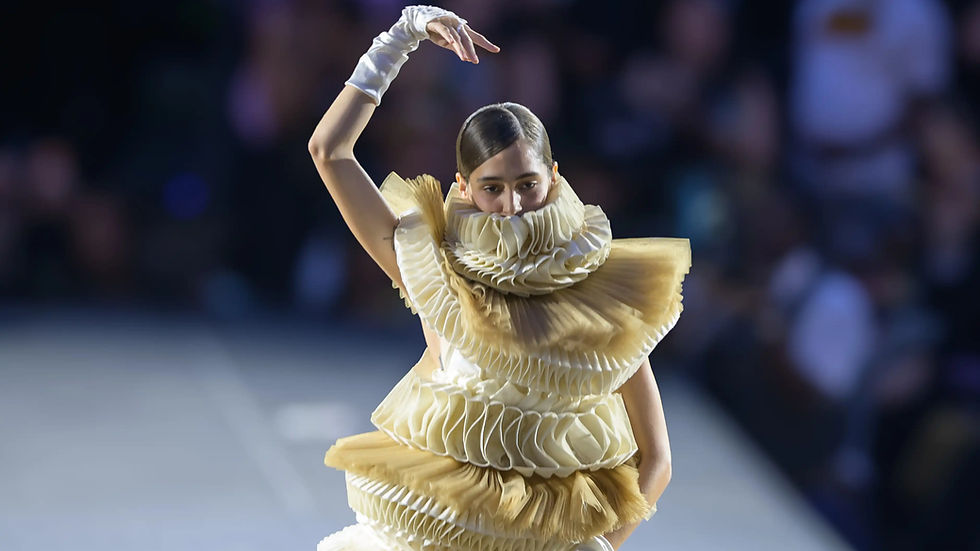
The second half moved into the fantasy world of the story, with florals, tapestries, ruffles and exaggerated silhouettes.
Siriano used hand-embroidered tapestry fabrics that felt almost like they had been pulled from an old European chateau and then pushed into something much more dramatic. There were three-dimensional bodices, enormous ruffles and silhouettes that leaned fully into the theatricality of the reference.
And honestly, this is where I think Siriano is at his best: When he goes all the way.
There was a hot-pink maxi gown with upside-down tulip sleeves that felt made for a red carpet. There were hand-painted sequin floral gowns and a black tulle minidress that looked almost like an explosion around the body.
These are the looks that make you remember why runway fashion is fun.
Not everything needs to be something you can immediately picture yourself wearing to brunch.
Sometimes I want the giant gown. Sometimes I want the ridiculous sleeve. Sometimes I want a dress that exists purely to make everyone in the room turn around. Siriano understands that kind of fashion. And I appreciated that he allowed the collection to be exactly what the story called for instead of trying to make the fantasy feel more practical than it needed to be.
AKNVAS
AKNVAS approached storytelling in a completely different way.
Christian Juul Nielsen's Spring/Summer 2027 collection, titled Swans Before Innocence, was inspired by Hans Christian Andersen's The Wild Swans and structured as a three-act story: “Eleven Shirts,” “Forest Nymphs,” and “Wild Swans.”
The first act was built around the story's eleven shirts, referencing the eleven brothers in Andersen's tale who are transformed into swans. Nielsen translated that idea into shirting, using mixed striped cottons, hand-applied floral and swan embroidery, and unexpected details that made something as familiar as a button-down feel much more playful.
Then the collection moved into the forest which was probably my favorite part.
The utility pieces became softer and more romantic, with blue jackets, sculpted denim, floral raincoats, miniskirts and sheer layers. Models carried oversized bouquets and branches in leather bags, making the idea of the enchanted forest feel almost literal without becoming costume-like. There were even flowers growing out of some of the accessories, which made the entire runway feel like it had been taken over by this strange, slightly surreal garden. And then came the final act.
The silhouettes became much more dramatic, with asymmetrical lace gowns pulled together with ribbons and ruffles, followed by sweeping high-low skirts made from clouds of tulle. Nielsen described this section as intentionally dramatic, and you could see why. The volume and movement of the skirts were meant to suggest wings, bringing the swan reference into the actual shape of the clothes.
What I really enjoyed about AKNVAS was that the collection did not just tell you what the inspiration was and then leave you to find it. You could actually follow the story through the clothes.
It started with the shirts, moved into the forest, and eventually became this full, romantic fantasy. Even the floral arrangements and accessories were contributing to the world of the collection. And underneath all of that fantasy, there was still a very wearable wardrobe. Shirting, denim, utility jackets and everyday pieces were constantly being pushed against the more elaborate gowns and tulle silhouettes.
That balance is what made the collection work for me. It felt like a fairy tale, but one that you could actually get dressed in.
NEW YORK MEN'S DAY
New York Men's Day brought together eight emerging designers for its Spring/Summer 2027 edition, including Avon Anglers, Alienant, Ethan Lewy and Christopher Lowman.
AVON ANGLERS
Avon Anglers approached menswear through a distinctly American vocabulary, with utility, workwear and classic wardrobe staples coming together in a way that felt grounded but considered.
There was an appreciation for clothes that can actually be lived in without making practicality the entire point.
ALIENANT
Alienant took a different approach, presenting a genderless perspective that allowed traditional menswear boundaries to become much less rigid.
The collection did not feel like it was trying to force a conversation about gender. The clothes simply existed outside of the expectation that certain silhouettes belong to one gender
.
ETHAN LEWY
Ethan Lewy brought a more playful perspective to menswear, working with color, pattern and tailoring in a way that felt youthful without losing structure.
There was still a sense of classic menswear underneath it all, but the styling and proportions gave it a much more personal attitude
.
CHRISTOPHER LOWMAN
Christopher Lowman brought another contemporary perspective to the group, with a collection that felt connected to the way younger generations are actually dressing now.
Seeing these designers presented together made for a strong snapshot of emerging New York fashion.
PRIVATE POLICY
Private Policy made its connection to New York especially clear.
The Spring 2027 collection drew from basketball and the city's sports culture while also connecting those references to Chinese-American history.
One of the collection's most memorable pieces was a rugby shirt referencing 1972, the year of President Nixon's visit to China.
Athletic pieces appeared alongside pastel colors and more evening-oriented elements, creating a wardrobe that moved between completely different sides of the city. I liked that the references did not feel forced.
It felt like the kind of cultural combination that actually makes sense in New York, where sports, history, immigration, nightlife and fashion constantly overlap.
THE BLONDS
The Blonds celebrated 20 years in the way only The Blonds really could: with a lot of glamour, a lot of crystals and a lot of spectacle.
The anniversary show looked back through the label's history, bringing archival looks onto the runway alongside new designs.
But one of the most memorable parts of the show was the collaboration with Motorola.
The brand's razr phones became part of the fashion itself, with the technology incorporated into the styling rather than simply appearing as a product placement.
And then came Paris Hilton, closing the show in a custom crystal-covered look inspired by the Motorola razr, carrying the Meteorite version of the phone.
It was almost impossible to separate the phone from the outfit. And honestly, that was the fun of it.
Paris Hilton, The Blonds, Swarovski crystals, Motorola and New York Fashion Week all coming together in one very Y2K, very glamorous moment felt completely on brand.
For a label built around celebrity, nightlife and unapologetic glamour, a crystal-covered flip phone felt less like a collaboration and more like another accessory in The Blonds universe.

A SEASON OF MILESTONES
There was an unusual amount of history being celebrated this season.
KHAITE marked 10 years.
The Blonds marked 20.
Carolina Herrera marked 45.
Coach marked 85.
And Sabyasachi returned to New York two decades after his last runway show in the city.
But after seeing these collections, what interested me was less the number attached to each milestone and more what the designers chose to do with it.
Some looked into their archives. Some pushed their signatures somewhere new. Some brought their cultural histories into a completely different space. And some simply celebrated.
That, more than any one trend, is what I took away from Spring/Summer 2027.
There wasn't one way to dress, one story to tell, or one aesthetic that defined the week.
There were designers with very different points of view, all showing us exactly what they wanted fashion to be.
And that is what I love most about New York Fashion Week.
One show can be romantic. The next can be theatrical. The next can be rooted in heritage, sports, technology, tailoring or pure spectacle.
They do not have to agree.
They just have to make you want to keep watching.
Want to see more from this season of New York Fashion Week? I’m sharing more runway moments, designer coverage, and behind-the-scenes Fashion Week content on my blog at iamtaniagrover.com and on Instagram at @taniagrover.
Follow along for more fashion, culture, and everything happening beyond the runway.

Comments