
Mollie Elizabeth Is Ready For The Puppet Show

Updated: Feb 14
From a young age, Mollie knew she wanted to be a singer. Although she admits it didn’t become a plausible possibility until she was much older.
Growing up to the sound of Fever by Peggy Lee, the old times remained engraved in her heart as a period of inspiration. “I took a lot of 50s inspiration for Dirty Blonde, and I think even now, for the new music, I am going back to the 40s, even 30s,” she confesses.
There’s an innocence and timelessness that make old music incredibly special, uniquely capable of transporting the listener to a different world. “At the same time, there’s this kind of off-setting feeling to it because it’s so different from the stark, clean music we have today,” Mollie says.
It’s not the first time that modern artists choose to look back in time and draw references from a period of time where everything seemed fairly charming.
“I have heard that my music sounds a lot like Lana Del Rey’s or Melanie Martinez but I think that’s because we all have similar inspirations of going back to that era.”
Similar to Del Rey’s public image, Mollie’s style takes references from old movies and cult icons like Bardot’s character in When God Created Woman, and Monroe’s in Gentlemen Prefer Blondes. Embracing hyper femininity and the whimsical, childlike feeling of dressing like a princess is something she has always been conscious of. “The way I dress is a form of escapism. My whole life is kinda like that, actually,” Mollie says as she discloses that the media being created right now seems awfully real and gory.
“I think we are so much in this era of realism, of making it feel as real as possible, making it feel as if you were there and I think part of the charm of watching a movie and going to the theatre is that it feels like a movie, it doesn’t feel like a theme ride park, it doesn’t feel like we have a headset on and we can smell what’s going on. It's like the charm and the ease of it is lost in a lot of media these days,” Mollie shares.
While imagination is important, living in a constant escape mode can be incredibly draining and often ineffective.
“Last year, I was in Los Angeles, and I became hyper fixated on creating this fantastical, happy world building with the songs that I was writing, and, interestingly enough, it just wasn't connecting with people,” she admits.

We live in a time where chaos prevails, where there seems to exist no clear path. “People feel scared, people feel uneasy, and I think that, to an extent, they want comfort and they want distance from that, but you can’t take away the underlying feeling of discomfort. I think it’s all about creating this fantastic world where we can all cry together and we can be upset, we can be trouble, but we can also wear our ball gowns.”
There should always exist an awareness when creating a message that connects with people, but that remains intrinsically true to the artist. “That’s the difficulty with art sometimes. Even if you create this persona that you step into, it’s always going to come from something you have experienced or something you have watched,” the singer-songwriter reflects.
When it comes to creating songs, Mollie’s process is as comfortable as possible. “I am such a psycho about it,” she laughs. A dark room, a neon pink stress ball, and a rhythm to start. Some instruments are incorporated as the cords dictate, as the lyrics start to form. “I play the ukulele and a little bit of the piano,” Mollie says as she admits that inspiration can come from everywhere, and even she has created a song to the sound of a washing machine.
While the right tools are left to be found by those who look for them tirelessly, music remains a tricky industry to be involved in. “Something I hear from producers is always them saying that if they were interested in marine bio, they would totally do that instead. Music is so uncertain and vulnerable. Every song is a little piece of my soul, a little piece of my heart.”
Passion can easily be subdued when lyrics start to culminate as paychecks. “This is something that I have been experiencing," she confesses. “I am selling a product, and that’s my music, myself, and my presence. Sometimes I will make a song that I love, and that I think is really good, but then when I make a post with it, it just doesn’t perform, the numbers don’t do well.”
Artists are left in a limbo, where creativity clashes with business analytics and learning how to make their presence stand out in the middle of the crowd. “You have to know your audience, do they want a sadder song or a weird arrangement?" she shares.
There’s an unpredictability right now that makes it harder for musicians to pursue their craft. The published illusion of the American Dream is crumbling as the weight of real-life responsibilities increases drastically. “There was a time where artists would put a song out, perform, and then go work at a diner at night. Now, you have to write, perform, be an Instagram model, be on TikTok, and you have to go work at a diner at night while also being a barista in the morning because rent has tripled.”

The proliferation of content on social media is something that has been discussed at length, with many artists confessing their discontent with having to have an online presence in order to remain culturally relevant. “I had a hard time with it last year, just because it felt very disingenuous to be on social media. I am already juggling all things in my personal life and my career, and if I am an artist, that’s all I should have to do. Just make music and perform it,” Mollie admits.
Even if everything seems overwhelming at times, social media has its benefits. It generates a wider audience that allows artists to perform worldwide, even if doing so with few resources. “I try to shift my mindset and think that this is how I connect to people,” Mollie admits as she discusses how corporate music has become lately, stating that a lot of big record labels put the artist in a box that generates money but never allows professional growth.
There has always existed an underlying difference of interests between what powerful companies want and what audiences crave. “People want movies to be movies and artists to be artists. They don’t want artists to be industry plants,” Mollie shares as she says that people are ready to lie in bed with their headphones on, listening to music and resonating with it, while knowing that there’s a lot of time being spent in the studio.
Being an artist is to perform constantly. “Part of the reason why people love you is because you’re always on - you’re always responding, you have quick responses, you hold yourself right, and then you’re by yourself, and it’s all quiet,” she confesses.
The crowd can be intoxicating. You enter the stage to look down upon thousands of people who bought tickets just to see you perform; it feels like a dream, but it’s only exhilarating until the applause fades. “It’s like a drug. And there’s something really uncomfortable about all of that. There’s a sense of addiction in this culture where they want you to perform every night, go party every night, and then every boost of energy becomes intoxicating,” the singer admits.
When she is not singing, Mollie likes to read dystopian novels, nap, bike, and go for walks in the forest where the trees are a constant reminder that nothing is as serious as it seems. “So much of it is ego. When I go out into the woods, and there are two hundred-foot-tall trees, I realise that this is not about me. There’s so much more to life, and you have to experience it, you know. Go on crappy dates - write songs about it, of course - take up knitting, make new friends, and take a deep breath,” she says.
As someone who always gravitates towards the fantastical, the singer likes to use one small trick that helps her navigate the harder times. “I like to imagine that I am just a little bird, I am so small, and that’s great.”
Although there’s not much that can be revealed about the upcoming album, there seem to be only a few adjustments to be finalized behind the scenes. “There are a lot of behind-the-scenes things to be finalized, but fans can sign up to pre-save things on my Instagram. There are many, many exciting things coming soon. I wish I could say more,” she laughs.
While Mollie thinks that artists should always advocate for themselves, this seemingly easy action gets progressively difficult if you’re a woman, notably a young woman. Her soon-to-be-released song Puppet Show tackles this matter openly. “Celebrities and beautiful women who have just cut open their faces and fill them with plastic. I want to focus on that type of stuff; it feels very unspoken.”
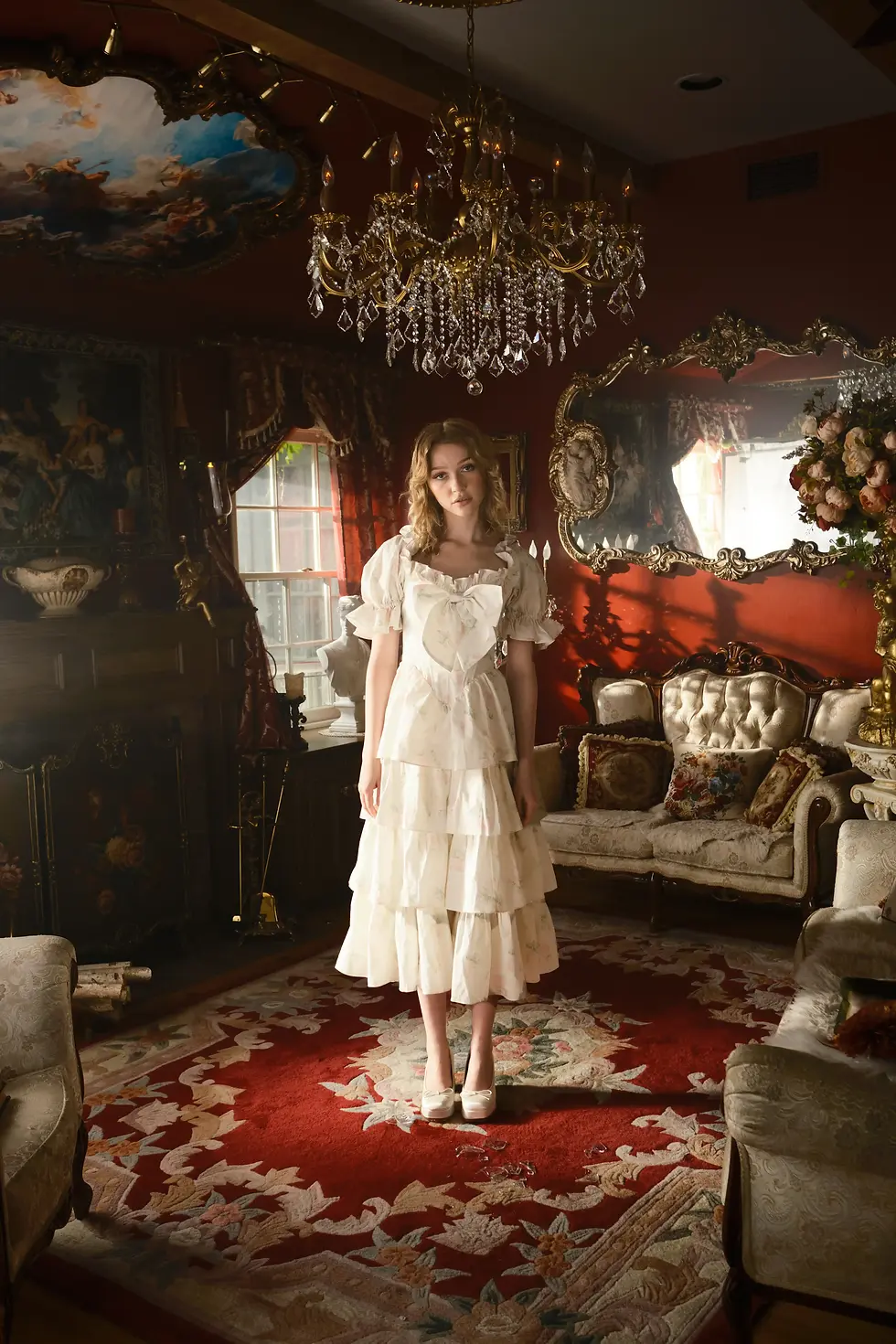
As the discourse surrounding plastic surgery increases and notorious media work, such as The Substance, discusses this topic bluntly, for Mollie, there’s still a lot of work to be done. “Maybe we should disclose this to young girls who are growing up, but it’s like this is exactly what they want; they want young girls to think, 'I don’t look like that. I have to go down to the clinic and get ready for the puppet show.”
At the same pace, Dog Eat Dog welcomes young girls to listen to what is soon to be expected of them. “It feels very comical and theatrical to me. If I don’t pluck my eyebrows, no boy is ever going to love me,” Mollie exclaims.
Women are always viewed as performers. Placed on a pedestal, they are expected to do more, to be perfect and interesting, intimidating but always nice and considerate.”I think women are always going to feel like they have to play a character and that’s something that Benson Boone or Post Malone are never going to understand,” she says.
To young girls growing up in this climate, notably those who consider a career in the music industry, Mollie’s ultimate advice stays firm: “No matter what happens, it’s about the music, and it's about you. This is yours, not theirs. This is not theirs to take. Do not ever let anyone tell you how to write your music, why to write, or what you can write about. Don’t ever let someone say your music is theirs and they deserve to own it; they don’t.”


this interview really nailed the push-pull between escapism and being forced to perform a persona online, and the “puppet show” framing hits hard. i also appreciate her admitting that the super-happy worldbuilding didn’t connect, because that’s such a real creative lesson. after reading it i doomscrolled a bit and ended up on https://crazyballsgame.org/ which felt exactly like the “content noise” she’s talking about. then a friend sent me https://icefishingonline.org/ and it was the same weirdly numbing vibe. even https://crazytimeonline.org/ gave me that hollow “numbers and dopamine” feeling she describes, which made her point land more for me. i’m curious how she’ll balance the vintage glamour with more blunt writing on the new record.