
Meg Fraser on Angel and the Badman, Finding Strength in Kindness, and Redefining Success

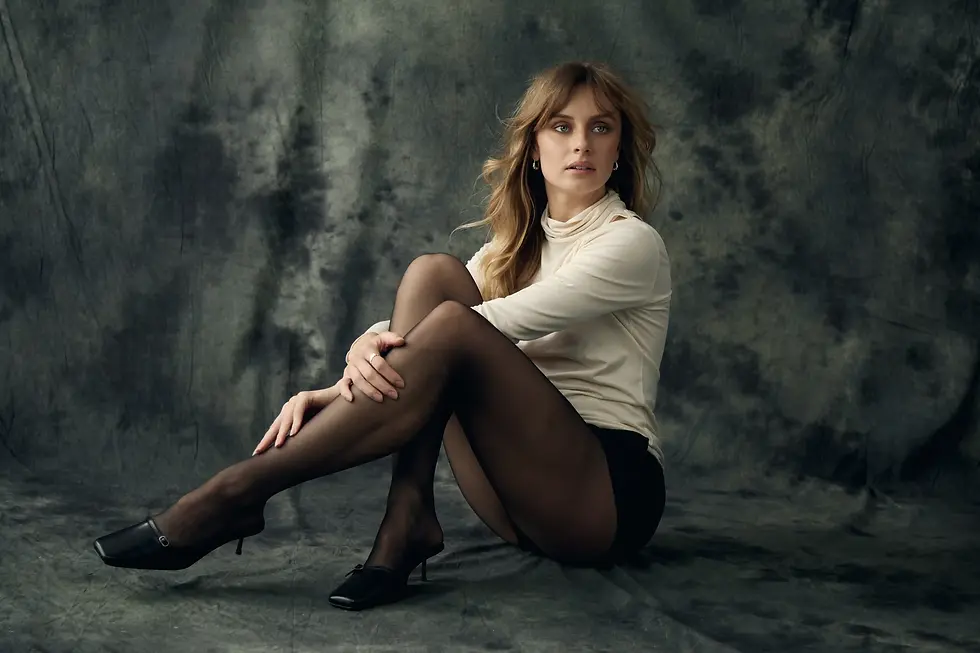
Photography by Harry Hayes
For Australian actress Meg Fraser, stepping into the world of Angel and the Badman represents both a career milestone and an unexpected return to something familiar. Having grown up watching Westerns with her grandfather, a devoted John Wayne fan, Fraser now finds herself at the center of a modern reimagining of the classic film, starring opposite Zachary Levi, Tommy Lee Jones, and Neal McDonough.
As Penny, a woman whose compassion is matched by fierce independence and unwavering conviction, Meg brings a nuanced perspective to a character who challenges traditional notions of strength. It is a role that reflects her growing interest in characters whose complexities extend far beyond what audiences first see.

Having built her résumé through projects including Bloody Hell, Barons, and Take My Hand, she now approaches this new chapter with a perspective shaped by experience rather than expectations. For Meg
, success has become less about a singular breakthrough and more about longevity, creative curiosity, and the freedom to take risks. In conversation with LO’AMMI, she discusses the experience of bringing Penny to life, the lessons learned from her fellow cast members, her ambitions beyond acting, and why finding fulfillment outside the industry matters just as much as the work itself.
Angel and the Badman marks your first major theatrical leading role! What initially drew you to Penny, and was there something about her character that immediately felt personal or familiar to you?
I was immediately drawn to Penny's strength of character. She has this unwavering belief in the goodness of people, which I think is quite a remarkable quality, particularly in the world she inhabits. She's compassionate and gentle, but there's also a real stubbornness to her that I loved.
I think what felt familiar was her independence. She's someone who knows her own mind and isn't particularly interested in changing herself to accommodate other people. I really connected with that. And I loved that her strength didn't need to manifest in a traditionally masculine way. Her convictions, her kindness, and her ability to stand her ground are what make her powerful.
Penny is seen as compassionate but also remarkably strong-willed. How did you approach balancing her kindness with her independence, and what did you want audiences to understand about her beyond the romantic storyline?
I never really saw those qualities as being in opposition. I think there's an enormous amount of strength in being kind, particularly when that kindness is a conscious choice rather than something that comes from naivety.
Penny has a very clear moral compass, and her beliefs are central to who she is. But she's also practical, capable, curious, and quite stubborn. I wanted to make sure that her compassion didn't come at the expense of those other qualities.
And while the romance is obviously a significant part of the story, I think it's important that Penny has a life and an identity that exist independently of Quirt. She's not waiting for someone to come along and complete her.
What was it like working alongside Zachary Levi, Tommy Lee Jones, and Neal McDonough, and was there a particular moment on set that stayed with you?
It was a pretty extraordinary group of people to find myself working alongside. They all bring such different experiences and approaches to the work, and I think there's so much to be gained from observing actors who've spent so many years doing what they do.
What I really appreciated was how prepared everyone was, but also how open they were to discovering something new in a scene. There was a real generosity in that.
Working with Zachary was particularly lovely because so much of Penny and Quirt's relationship relies on their differences. Finding the humour, tension, and affection within that dynamic was a lot of fun. I think some of my favourite moments were when we could surprise each other a little and allow the scene to go somewhere we hadn't necessarily anticipated.
As an Australian actress stepping into a modern reimagining of a classic John Wayne Western, what surprised you most about working in the genre, and how did the experience compare with your previous projects?
I grew up watching quite a few Westerns with my grandfather, who's a huge John Wayne fan, so there was something really special about finding myself in one.
I think what surprised me most was how intimate the genre can be. We tend to associate Westerns with these enormous landscapes, horses, guns, and action, but at the heart of the really good ones are often quite simple human stories about morality, belonging, and the choices people make.

I've been lucky enough to work across quite a few different genres already, and I think the wonderful thing about acting is that the world around you can change completely, but the fundamental work remains the same. You're still trying to understand a person, what they want, and why they behave the way they do.
Although I will say, getting to walk around a Western set in New Mexico was a pretty wonderful way to spend a working day.
Looking back at projects like Bloody Hell, Barons, and Take My Hand, what have those earlier experiences taught you about yourself as an actress, and how has your relationship with the industry evolved?
I think each project has taught me something quite different. Bloody Hell was my first feature, and I was really thrown into the deep end. I learnt an enormous amount about the technical side of filmmaking, but also about trusting my instincts and finding my feet in an environment that was still very new to me.
Since then, I've become much more comfortable with the fact that there isn't necessarily one right way to approach the work. Different directors, actors, and projects require different things from you, and I think being adaptable is such an important part of the job.
My relationship with the industry has definitely changed as well. When I was younger, I think I was much more concerned with getting things right or proving that I deserved to be there. Now I'm far more interested in being curious, taking risks, and enjoying the process.
A breakout moment is often the result of years of work audiences haven't necessarily seen. Does this point in your career feel like a turning point, or has your definition of success changed over time?

I think it's a little bit of both. I'm incredibly grateful for the opportunities I've had recently, and there's definitely a sense that things are moving in an exciting direction. But I also know how much work has gone into getting here, and how much more there is that I want to do.
I started acting quite young, and I think when you're starting out, it's easy to imagine that success is going to be this very definitive moment where everything suddenly changes. The older I get, the more I realise it's rarely that straightforward.
For me, success has become much more about longevity. I want to build a career that allows me to keep working with interesting people, telling stories I care about, and continuing to challenge myself. Of course, there are milestones I'm ambitious about reaching, but I don't want to spend my whole career waiting for the next thing to happen before I allow myself to enjoy where I am. But that is easier said than done.
With upcoming projects like Wolf Creek Legacy and Welcome Back to My Channel, you're exploring some very different creative worlds. What excites you about moving between genres, and are there particular kinds of characters or stories you're hoping to explore next?
I love moving between genres. I think one of the great privileges of being an actor is getting to inhabit worlds and explore experiences that are so different from your own.
I've always been drawn to characters who are a little complicated. People who might present one version of themselves to the world but have something quite different happening underneath. I think those contradictions are where the most interesting work lives.
I'd love to continue exploring more complex dramatic roles, particularly stories that aren't afraid to sit in uncomfortable or morally ambiguous territory. I'm also really interested in the idea of producing and being involved in developing projects from an earlier stage.

Ultimately, I don't think I'm particularly attached to one genre. I love them all. It's usually the people involved, whether that's the director, producing team, or fellow actors, and the script that get me excited about a project first. But if I had to pick one to do next, fantasy would be pretty cool. There are so many exciting book adaptations at the moment, and getting to be a part of one is definitely on my bucket list.
When you think about the person you want to become over the next few years, both creatively and personally, what matters most to you, and what are you most looking forward to discovering?
I think more than anything, I want to keep growing and remain curious. Creatively, I hope I continue to become braver in my choices and more willing to explore things that might feel a little outside my comfort zone.
I'm ambitious, and there are certainly things I want to achieve, but I also want to make sure I'm building a life outside of my work that feels equally fulfilling. My relationships, my family, my friendships, and having a sense of community are all incredibly important to me.
I think I'm most looking forward to seeing how my perspective changes as I get older. Every few years, I look back and realise how differently I see certain things, both personally and creatively. I hope that continues. I think the more life you experience, the more you have to bring to the work.


Comments