
Leonardo Nam on Descendants: Wicked Wonderland and Maddox Hatter’s Darker Evolution

For Leonardo Nam, returning to Wonderland meant discovering just how far a familiar character could transform. In Descendants: Wicked Wonderland, the actor reprises his role as Maddox Hatter, trading the warmhearted inventor and mentor audiences first met for a wounded, unpredictable figure shaped by the consequences of an altered past. Rather than approaching Maddox as a traditional villain, Nam searched for the humanity beneath the anger, drawing on physical theatre, music, and even the image of an unstoppable tidal wave to create a performance unlike anything he had done before.

That willingness to venture into unfamiliar territory has long defined Nam’s career. Born in Argentina to Korean parents, raised in Australia, and now working in the United States, he brings a deeply global understanding of identity and belonging to both his performances and his work behind the scenes. Through Good On Ya Productions, Nam is developing stories that reflect the layered, multicultural lives of people too often reduced to a single label.
In conversation with LO’AMMI, Nam discusses Maddox’s darker evolution, the fear and exhilaration of singing and dancing for the first time, the industry’s continued journey toward more complex representation, and how fatherhood has reshaped his understanding of success, creative risk, and the legacy he hopes to leave behind.
In Descendants: Wicked Wonderland, Maddox enters the story from a dramatically different angle than audiences first met him in Rise of Red. What excited you most about returning to the character in this way?
One of the things I love most as an actor is not repeating myself. Returning to Maddox gave me the chance to explore a completely different side of someone that audiences thought they already knew. In The Rise of Red, he was this inventor, mentor, and friend with a huge heart. In Wicked Wonderland, that same heart has been wounded, and I was fascinated by what happens when someone carries that kind of hurt.
For me, the challenge wasn't playing a darker character. It was understanding the emotional journey that got him there. Hurt can become anger, obsession — even madness — and exploring those emotional colors made Maddox feel much more human and three dimensional. That's always what excites me as an actor.
Maddox is ultimately shaped by the consequences of Red and Chloe changing the past. Without revealing too much, what does he believe he's fighting for, and how did understanding that help you find the humanity beneath the villainy?
I never approached him as a villain. I approached him as someone who had been deeply hurt and believed he was fighting for something that mattered.

In the previous film, audiences met someone with a heart of gold. In this story, that same heart has been broken. He's searching for redemption, trying to reclaim the truth as he understands it, and that obsession slowly consumes him.
As an actor, that's much more interesting than simply playing someone who's evil. Real people are complicated. They can be capable of love, fear, jealousy, hope, and desperation all at the same time. I wanted Maddox to feel like someone whose humanity was still there, even when his choices became darker.
Wonderland gives an actor permission to be theatrical, unpredictable, and physically expressive. How did you develop Maddox's movement, voice, and eccentricity? Did your clown training influence the performance?
Absolutely. Every tool I've collected over the years found its way into Maddox. My clown training definitely played a role because it teaches you to fully commit to physicality, rhythm, and play. I also worked extensively on finding his voice and movement until they felt like they belonged to him.
One image that kept coming back to me was a tidal wave. It's one of the few things in nature that genuinely frightens me. It's beautiful, powerful, and unstoppable. That became a metaphor for Maddox. Once he's set in motion, he changes everything around him.
That idea even influenced how I moved through the costumes, especially the long coats and dramatic silhouettes. I wanted him to feel like a force of nature sweeping through Wonderland.
Music was another huge influence. I found a lot of inspiration in Green Day and Ozzy Osbourne. There was something about their energy and unpredictability that helped me find Maddox's eccentric spirit.
This franchise brings together a new generation of performers alongside iconic artists like Brandy, Rita Ora, Kylie Cantrall, and Malia Baker. What did that mix of experience and youthful energy create on set? Was there a moment when the scale of the Descendants world really hit you?
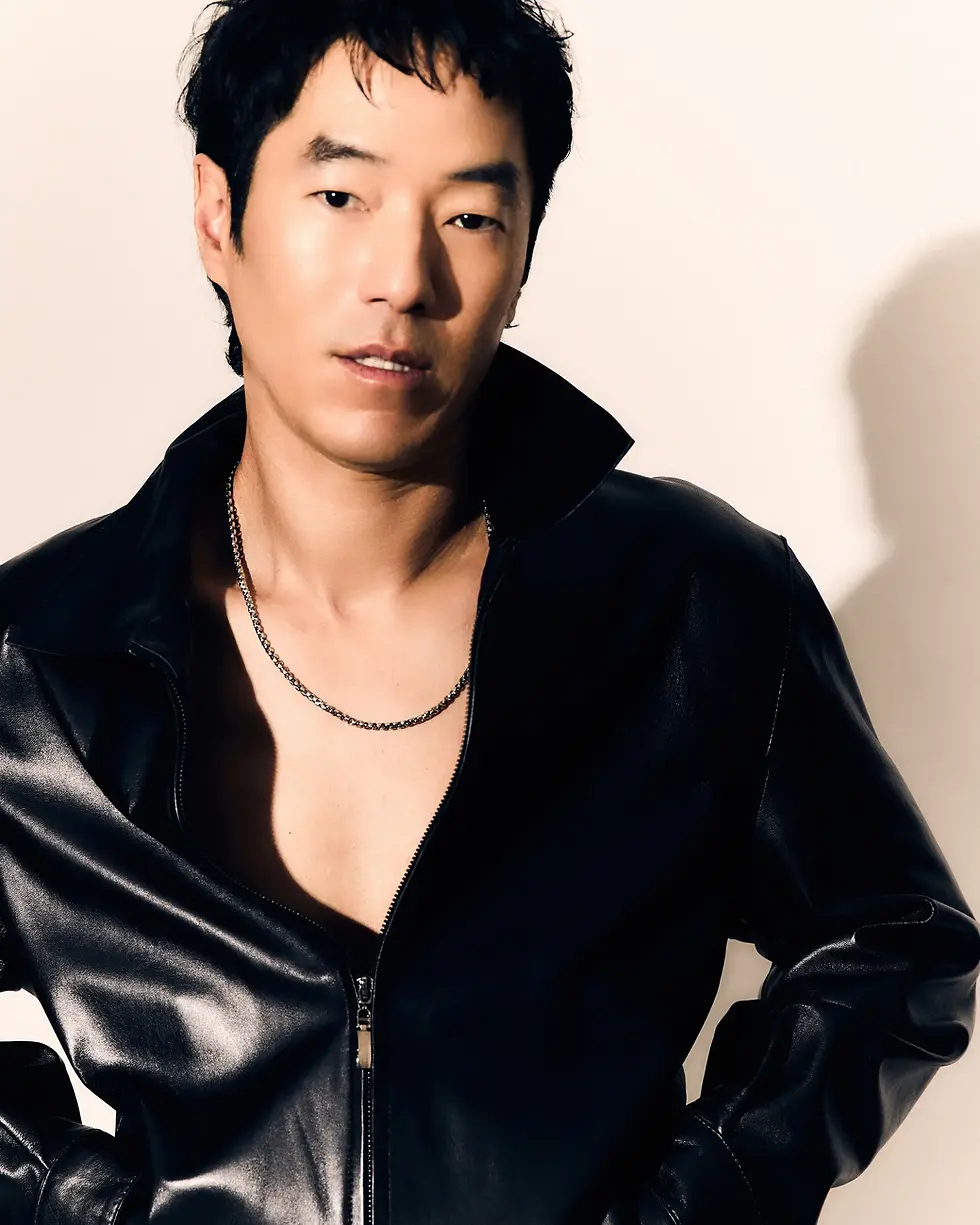
It was such a joyful set. There was this wonderful balance between experience and fresh energy, and everyone genuinely wanted one another to succeed. That creates a very special environment creatively.
For me, one of the biggest moments was realizing I'd be singing and dancing in a Disney film. I'd never done either professionally before, so it was honestly terrifying, but also incredibly exciting. Those are exactly the kinds of opportunities I'm always looking for because they push me somewhere new.
Standing there, performing alongside artists I've admired for years, I remember thinking, "This is pretty incredible." It really hit me that I was part of something much bigger than just another job. I was a part of a Disney franchise that's meant so much to audiences around the world, and that's something I'll always be grateful for.
Several years ago, you wrote about saying yes to the life you envisioned and even expressed a desire to be part of a major film franchise. Looking back now, what does it mean to see that intention realized through such a pivotal role in the fifth Descendants film?
It's a great reminder that growth often begins by saying yes before you feel completely ready. When Descendants Wicked Wonderland came along, I'd never sung or danced professionally before. That was intimidating, but it was also exactly why I wanted to do it.
I've always hoped to be part of a major franchise because it gives you something that's rare as an actor: the opportunity to keep evolving a character over time. You're not telling a single story. You're watching someone change, make mistakes, grow, and surprise both the audience and yourself. That's been one of the greatest gifts of playing Maddox.
Born in Argentina to Korean parents, raised in Australia, and having built your career in the United States, how has living between cultures shaped the way you see character, belonging, and the kinds of globally minded stories you now want to develop through Good On Ya Productions?

Growing up across different cultures taught me that identity isn't one thing. It's layered. I've always been fascinated by how people naturally code switch between different cultural environments and how those experiences shape who we become.
That perspective has influenced every character I've played, but it's also become the foundation of Good On Ya Productions. More recently, I also learned that I have Japanese heritage, which added another layer to understanding my own story.
Today, so many families live across multiple cultures and countries. My children are American and Korean, and they were born in Mexico. That's simply their reality, just as it is for millions of people around the world. I want to create stories that reflect those layered identities because I don't think we've seen enough of them yet.
We live in an age where people feel connected to the world, not just the place they grew up in. Our stories should reflect that. I think audiences are ready for characters whose identities are just as global and layered as their own.
Throughout your career, you've spoken about bringing greater dimension to characters who might otherwise be limited by stereotypes. Do you feel the industry has progressed from simply including underrepresented actors to allowing them genuine complexity? Where is there still work to be done?
We've definitely made progress, and that's exciting to see. But I also think the next step is moving beyond representation toward truly complex storytelling.
I'm fascinated by ordinary people. The dishwasher at a restaurant, the ticket seller at a train station, someone you pass by every day without thinking twice about. Every one of those people has a rich inner life, dreams, heartbreak, humor, and contradictions. Those stories deserve to be told just as much as the obvious heroes.
That's part of why I started Good On Ya Productions. I want to help create stories that embrace complexity — not just culturally, but emotionally as well. I think audiences are looking for characters who feel real; whose identities are layered and whose lives don't fit neatly into one category. Those are the stories that stay with us.
As a father, what do you hope your children take away from seeing you in a fantastical family franchise like Descendants? Has parenthood changed the way you think about success, creative risk, and the legacy you want to leave behind?

One of my favorite memories was at the premiere in Los Angeles. It was the first time my boys had seen the film, and instead of watching the screen, I found myself watching them. Seeing their faces light up, hearing them laugh, and watching them get completely pulled into the story was incredibly emotional. They're nine years old, and I know this will be one of those memories we'll share for the rest of our lives.
Parenthood has completely changed how I define success. Earlier in my career, success meant booking the next role. Today, it's about building something that lasts.
Starting Good On Ya Productions was really my way of having my own back. It's about believing in the stories I want to tell and not waiting for permission to make them. I hope my children grow up knowing they don't have to ask permission to pursue the life they imagine. They can do the work, take the risk, and build it themselves.
Ultimately, that's the legacy I hope to leave, not just for my kids, but through my work. I want to tell stories that help people feel seen, celebrate the richness of who we are, and remind us that our differences, our cultures, and our experiences aren't things to simplify. They're what makes us human.


일정 조율이 쉬워 개인 생활과 병행하기 좋습니다. 중간에 관련 내용을 포함하니 활용성과 장점이 잘 드러나 독자 입장에서 이해하기 밤알바 편했습니다.
컨디션 관리와 휴식을 함께 챙기려는 분들에게 장소와 시간의 편리함을 제공하는 방식이 인상적입니다. 별도 이동 없이 이용할 수 있다는 점에서 접근성과 편의성이 수원출장마사지 좋습니다. 이동에 필요한 체력 소모를 줄이고 관리 전후의 시간까지 효율적으로 활용할 수 있습니다.
Anyone who enjoys mystery and deduction will find That's Not My Neighbor packed with suspicious encounters, document checks, and constant uncertainty.